The H-index, called “Hirsch Index,” suggested by Jorge E. Hirsch, is a widely used metric to measure the impact and productivity of a researcher based on their publications. It has become a standard tool for evaluating academic performance, especially in disciplines such as science, technology, engineering, and medicine.
In this article, we will explore i) what the H-index is, ii) why it’s important, and iii) how researchers can check their own H-index on platforms like Scopus.
What is the H-Index?
The H-index was proposed by physicist J. Hirsch in 2005 as a way to quantify the cumulative impact of a researcher’s work. The metric is calculated based on two factors:
- The number of publications a researcher has.
- The number of citations each of those publications receives.
A researcher has an H-index of h if they have h papers that have been cited at least h times. For example:
- A researcher with an H-index of 10 has 10 papers that have each been cited at least 10 times.
This metric balances both productivity (number of papers) and impact (citations per paper), making it a valuable indicator of a researcher’s academic influence.
Why is the H-Index important?
The H-index is widely regarded as an important metric because:
a) It reflects both quantity and quality: unlike raw citation counts, the H-index ensures that a researcher’s influence is measured by consistent impact across multiple works rather than a single highly cited paper.
b) career evaluation: many institutions and funding agencies use the H-index as part of their criteria for promotions, awards, and grants.
c) comparison tool: it allows a comparison between researchers within the same field, although it is less effective for comparing researchers across different disciplines with varying citation norms.
d) longevity of impact: a growing H-index over time indicates sustained influence and contribution to a specific field.
Limitations of the H-Index
While useful, the H-index is has different limitations, the following:
- Field-specific differences: citation patterns vary greatly across disciplines. For example, researchers in medicine often have higher H-indices than those in the humanities.
- Neglect of co-authorship roles: the metric does not account for the level of contribution in co-authored papers.
- Bias against early-career researchers: those who are just starting their academic careers may have a low H-index despite producing high-quality work.
- Database dependency: the H-index can vary depending on the database used (e.g., Scopus, Google Scholar, or Web of Science), as each platform has its own coverage of publications and citations.
How to check your H-Index on Scopus
Scopus is one of the most reliable platforms for calculating the H-index due to its comprehensive database of peer-reviewed literature. Here’s how you can check your H-index in Scopus:

1.Access Scopus: go to the Scopus website and log in. If your institution provides access, you may need to use institutional credentials.
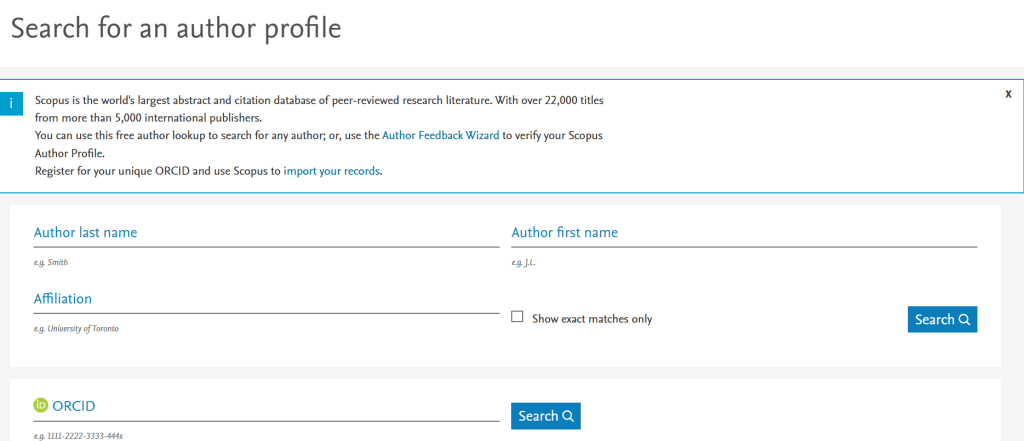
2.Search for your profile: use the “Authors” search tab and enter your name, affiliation, or ORCID ID.
Scopus will display a list of authors matching your search criteria. Here is an example:
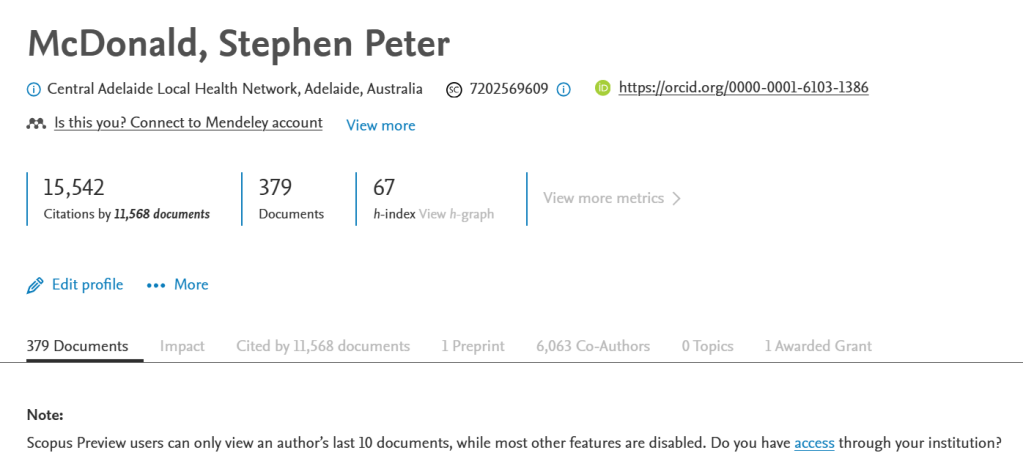
3. View your author profile: click on your name to open your author profile.
Your profile will display key metrics, including your H-index, total citations, and the number of publications.
4. Explore your citation metrics: Scopus also allows you to see detailed metrics for individual papers and visualise trends in your citation count over time.
Tips to improve your H-Index
If you’re looking to enhance your H-index, consider the following strategies:
- Focus on high-quality publications: aim for journals with a strong reputation and broad readership in your field.
- Collaborate strategically: co-authoring with established researchers can increase the visibility of your work.
- Present your work widely: share your publications on platforms like ResearchGate, LinkedIn, and academic conferences.
- Choose impactful topics: research topics of high relevance or emerging interest in your field often attract more citations.
- Keep your profiles updated: ensure your Scopus, ORCID, and other author profiles are accurate and include all your publications.
Have thoughts or questions about the H-index? Share them in the comments below!
 UNLOCK YOUR POTENTIAL
Leave a comment