1. Assisting with data analysis
While ChatGPT does not directly analyse data, it can provide support by explaining statistical concepts and helping researchers select suitable analysis techniques:
Explaining statistical tests: ChatGPT can describe different statistical tests and help you determine which one is appropriate for your data.
Guiding data interpretation: It can offer guidance on interpreting complex statistical results.
Coding support: For researchers who work with data in R or Python, ChatGPT can generate example code, troubleshoot errors, or suggest modifications.
Example prompt: “Explain how to conduct a chi-square test for independence and interpret the results.”
Example prompt: “Explain how to conduct a chi-square test for independence and interpret the results.”
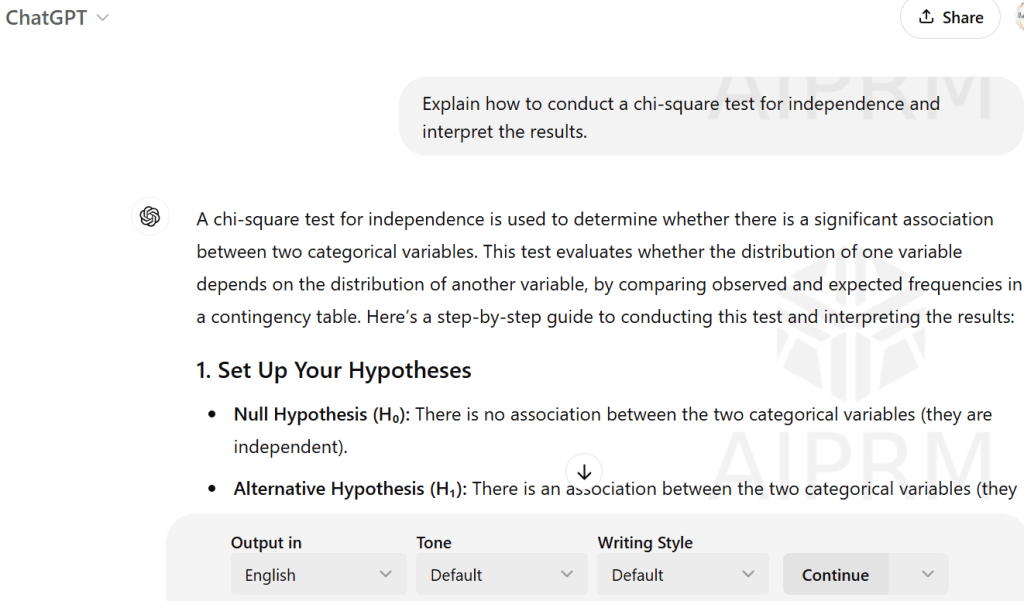
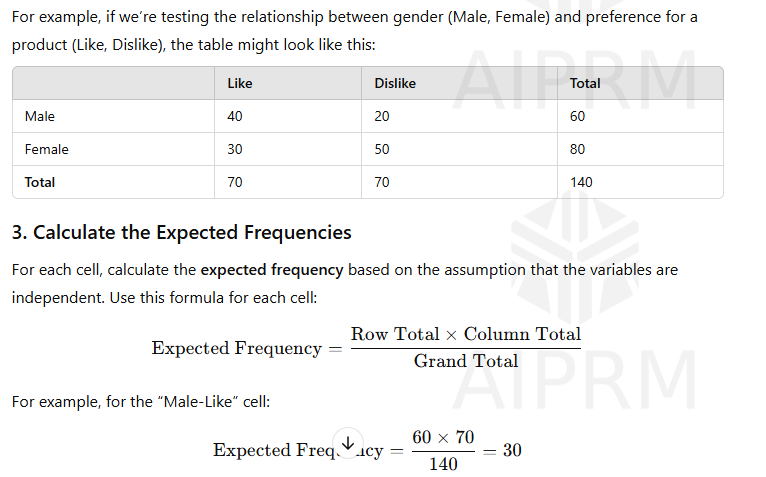
Here’s an example of a table built by ChatGPT:
2. Conducting a literature review
A thorough literature review is essential for any research project. ChatGPT can assist in multiple ways:
Summarising articles: ChatGPT can provide concise summaries of research articles, helping you grasp key findings without reading each paper in detail.
Identifying research gaps: By reviewing summaries of recent studies, ChatGPT can help you identify potential research gaps or areas that require further investigation.
Generating review outlines: Use ChatGPT to draft an outline for your literature review, organising studies by theme, methodology, or findings.
Example prompt: “Summarise the main findings of recent research on the effects of remote learning on primary school students.”
3. Developing research questions and hypotheses
ChatGPT is highly effective at brainstorming ideas, making it an invaluable tool for the initial stages of research planning:
Research questions: ChatGPT can help you brainstorm specific, testable research questions based on your area of interest.
Hypotheses: It can assist in formulating hypotheses that align with your research questions and objectives.
Conceptual frameworks: Use ChatGPT to explore potential frameworks, theories, or models that may support your study.
Example Prompt: “Suggest research questions for a study on the environmental impact of urban agriculture.”
4. Drafting research proposals
Writing a clear and compelling research proposal is critical to obtaining funding and approval. ChatGPT can aid this process by:
Outlining proposals: Ask ChatGPT to generate an outline for your proposal, including sections such as introduction, literature review, methodology, expected outcomes, and significance.
Describing methods: ChatGPT can provide standard descriptions for common research methods, making it easier to draft the methodology section.
Refining language: ChatGPT can help refine language and improve readability, ensuring your proposal is professional and persuasive.
Example prompt: “Create a research proposal outline for a study on the psychological effects of social media on teenagers.”
5. Drafting and editing manuscripts
Writing research manuscripts is often time consuming. ChatGPT can streamline this process by:
Drafting sections: Generate initial drafts for the introduction, literature review, or methodology based on your data and notes.
Paraphrasing and editing: ChatGPT can help rephrase sentences to enhance clarity or adherence to journal guidelines.
Improving readability: It can edit text to improve readability and flow, making your manuscript easier to understand for a broader audience.
Example prompt: “Draft a literature review paragraph on the role of artificial intelligence in healthcare.”
6. Generating tables, summaries, and visuals
Researchers often need tables and summaries to present their findings concisely. ChatGPT can:
Create summary tables: Provide summaries of findings, methodologies, or data in a table format.
Generate content for figures: Suggest labels, captions, or brief descriptions for figures and graphs based on the data.
Visual suggestions: While ChatGPT doesn’t create graphics, it can suggest types of visualisations (e.g., bar charts, line graphs) suited to your data.
Example prompt: “Summarise recent findings on climate change effects in a table format with columns for year, author, country, and findings.”
Important considerations when using ChatGPT in research
While ChatGPT is a powerful tool, there are some key considerations to bear in mind:
Verify information: ChatGPT generates responses based on its training data, which may not always be current or entirely accurate. Always verify information against primary sources. Keep in mind that ChatGPT can sometimes produce hallucinations, or, more accurately, fabrications/inaccuracies/falsifications. If you’d like to learn more, here’s an article (published in Nature).
Maintain ethical standards: Be cautious when using AI-generated content. Ensure that all outputs meet your institution’s ethical standards and guidelines.
Use proper citations: If you use ChatGPT to assist with writing, it’s essential to cite sources properly. ChatGPT itself does not provide sources, so cross-checking and accurate citation are necessary.
Be mindful of confidentiality: Avoid sharing sensitive or confidential research data with ChatGPT, as it is an AI tool without built-in data confidentiality mechanisms.
 UNLOCK YOUR POTENTIAL
Leave a comment